- International Education
- Student Guidance
- ·
-
Jun 15, 2026
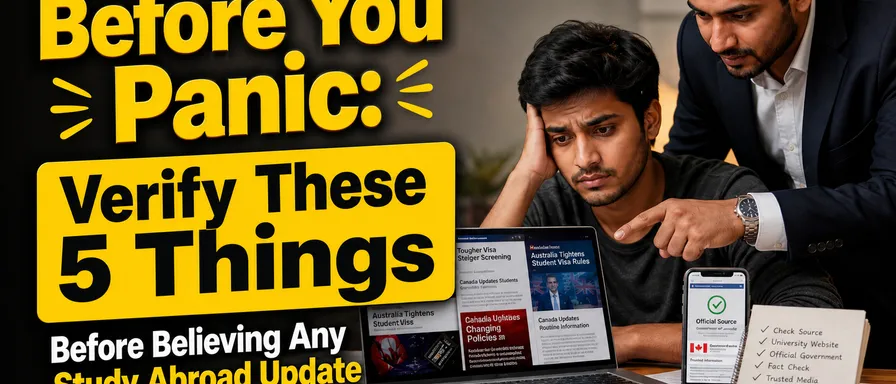
Before You Panic: Verify These 5 Things Before Believing Any Study Abroad Update
Social media is buzzing with study abroad updates every day. Before you panic over the next viral post, verify these five things to separate fact from misinformation.
Every student lives for the moment or holds on to the wish to study abroad, and we are very sure that you are wishing for the same no matter what the situation is. Studying abroad is one of the most exciting chapters in a student's life.
On the other hand, you wake up, check your phone, and suddenly realize that a post claims visa rules have changed or that countries are no longer allowing international students.
Studying abroad needs more than just a thought. Social media and your WhatsApp, buzzing with notifications full of unconfirmed information, can definitely make your dream fall apart in seconds.
The good part is that most situations become much clearer when you verify these five things, starting with the most important points first.
1. Check the Original Source of the Information
One of the biggest mistakes students make is trusting information simply because it has been shared multiple times. A post appearing in ten different groups does not automatically make it true.
Whenever you come across a major update, ask yourself a simple question: "Where did this information originally come from?"
- Was it announced by a government immigration department?
- Was it published on a university's official website?
- Did it come from a recognized education authority?
Many viral updates are actually screenshots without context, edited headlines, or interpretations of larger announcements. By the time the information reaches social media, important details are often missing.
Instead of relying on reposts, go directly to the official source. Government websites, embassy announcements, university portals, and official immigration departments should always be your first point of reference. The closer you are to the original source, the less likely you are to be misled.
2. Read Beyond the Headline
Headlines are crafted to draw readers' attention. Regrettably, they do not always capture the whole truth.
An example of a headline that initially seems shocking is "Country Tightens Up Student Visa Requirements". Nevertheless, after reading the rest of the text, you will find out that the requirement concerns just one particular type of student or applicants for one particular visa route. This happens often when it comes to study abroad news.
The problem is that students get shocked because of a headline without knowing all the details, deadlines, exclusions, or requirements. It leads to panic, although some applicants do not need to worry about changes at all.
When there is disturbing news in the field, spend a couple more minutes reading the entire text or announcement. Look for details such as:
- Who is affected?
- When does the change take effect?
- Are there exceptions?
- Does it apply to current students, future applicants, or both?
- Is the update permanent or temporary?
Understanding the complete context can make a huge difference.
3. Verify the Date of the Update
Sometimes, the biggest problem is not misinformation; it is outdated information.
Every year, there are changes to the laws concerning studying abroad. Changes occur in the visa process, university admission, and even the immigration process. However, outdated information tends to make its way back into circulation and can be passed off as new news. Students might get alarmed by reading information from two years ago, not realizing that it has long since become obsolete.
Before believing any update, always check:
- The publication date
- The announcement date
- Whether a newer version exists
- Any recent revisions or clarifications
A policy that was relevant six months ago may no longer reflect the current situation. In the study abroad industry, timing matters. An update is only useful if it is still valid today.
4. Cross-Check Information with Multiple Trusted Sources
Even if a news article appears to be credible, it is advisable to confirm it again using multiple sources that have been found trustworthy for the subject at hand. Trustworthy information is often included on multiple sites and formats which are widely regarded as reputable, such as educational institutions.
If there is a notable change in legislation regarding a particular issue, there should be multiple references to the change, as opposed to just one person posting it online.
For example, if you have become aware of changes to a country's post-graduation work rights, you should check the following types of sites for verification:
- Government immigration site
- Embassy (official site)
- University international student office
- Educational news source
- Licensed educational consultant
If all of the verified sources contain the same information, you can typically feel confident relying on it. However, if you only see one verified source discussing the subject matter and there are no other sources discussing the issue, it is best to conduct additional research before making conclusive judgments. Verifying can typically take a couple of minutes, but may prevent you from having unnecessary stress for several weeks.
5. Speak to an Expert Before Making Decisions
Probably the most crucial thing is to seek professional advice before making any changes to your study program.
Many students act too quickly following misleading information. Sometimes they delay applications, change destinations, or reject opportunities altogether because of hearsay which proves to be false later.
Study abroad programs differ from person to person. Something valid for one person may not work for another. Factors such as:
- Course level
- University choice
- Visa category
- Country of citizenship
- Application timeline
- Academic background
can all influence how a policy affects an individual applicant.
This is why expert advice remains valuable. A qualified study abroad advisor can help interpret updates, explain how they relate to your situation, and provide clarity when online discussions become overwhelming. Rather than reacting emotionally to every new headline, consult someone who understands the details and can guide you based on facts rather than speculation.
Conclusion
Going on a study abroad experience is exciting but can also become overwhelming as news updates come out almost every day. With the speed at which information travels, so too does misinformation. Because of this, being able to check news for reference has now become as important to the success of your application as preparing your application.
To calm your nerves over the next viral post or scary headline, keep these five things in mind:
- Check the original source.
- Read past the headline.
- Verify the date.
- Cross-check with other reputable sources.
- Consult with an expert before making any decisions.
Taking a few moments to verify information can save you days of worry and keep you focused on what is truly important: making your dream of studying abroad a reality.
While studying abroad can be an exciting experience, proper preparation can turn it into one of the most rewarding experiences of your life. Researching your study abroad destination, creating a budget, and learning about the culture of your study abroad destination will all contribute to an enriching and successful study abroad year.
Start Your Global Education Journey Today
Let Pine Overseas guide you to world-class universities across the globe. Book your free counseling session and turn your dream of international education into reality.