- International Education
- Student Safety
- ·
-
Jun 12, 2026
Fake Scholarship Offers: Warning Signs Every Student Should Know
Scholarship scams are getting smarter, smoother, and more damaging. Learn the warning signs every student should know to protect their money, data, and dreams.
Published by Pine Careers | Student Safety & Career Guidance
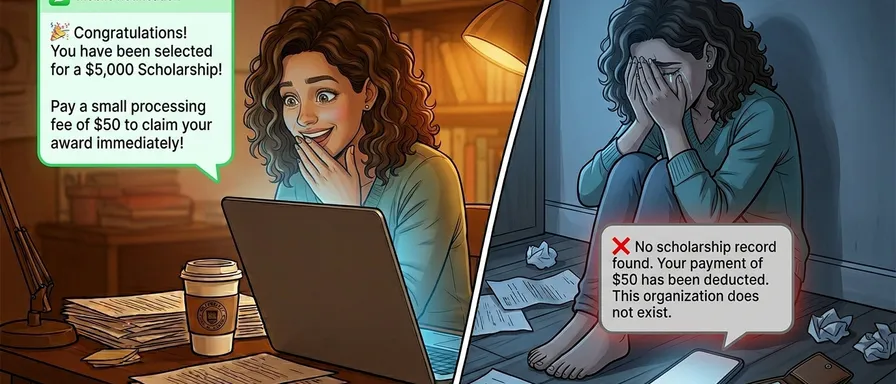
After spending a lot of time working on your application essay, you check your email to see if you received an update on your scholarship. The next morning, you check your email 17 times, and when you finally get a message that says you've been "selected" to receive a scholarship worth thousands of dollars, your heart starts beating fast, and your hands begin to shake. You take a screenshot of the email and send it to your mom before even finishing reading the entire message.
That excitement is real, which is what makes these scams so effective. Scholarship fraud is perhaps one of the most emotionally damaging forms of financial fraud in existence, because it doesn't just rob you of money; it actually robs you of hope. In 2025 and 2026, scholarship scams are changing, becoming smarter, smoother, and more damaging than ever.
At Pine Careers, we believe that every student should have the ability to find legitimate opportunities at no cost. So before you click "apply" on your next thrilling opportunity, let's discuss what's happening today, why these scams are still successful, and how to protect yourself from being defrauded.
Why Students Are the #1 Target of Scholarship Scams
Here is the truth: scammers choose students on purpose. It is not something that just happens. There is a reason they do this.
Think about your life now. You are in a spot. You do not have a lot of money. You are not sure what is going to happen in the future. Everyone tells you that you need to go to school to have a life. So you spend a lot of time looking for opportunities and filling out forms and writing essays. You really hope that someone will see how good you are and give you a chance.
The scammers know this. They know how you are feeling when you are trying to get aid. They study what you are going through. Then they make scholarships that they know will affect you when you are the most stressed out — when you are worried about paying for school and living and debt.
The Federal Trade Commission has some numbers that show how bad this problem is. In 2024, people reported losing more than $12.5 billion to scams. This is a lot more than the year before. What is even worse is that people from 20 to 29 years old lost money to scams more than any other group. A lot of these scams start on social media and with text messages.
Students are looking for aid on the internet where scammers are already doing their thing. The people who are trying to scam and the students who are looking for help are in the same place at the same time.
The emotional stakes are really high. A survey done by Gallup in 2023 found that 55% of people who did not finish college said the cost of university was the reason they left or did not enroll. When financial aid seems like the thing that can help you achieve your dreams, you are willing to believe things that seem too good to be true. That is not a flaw in you. That is just being human.
But here is the thing about people who scam students with scholarships. They do not just want your money right away. Sometimes the bigger problem is what they do with the information about you. Bad actors on the internet have used stolen student information to open bank accounts, apply for loans, and even steal someone's identity. In 2025, students at a university in Bangladesh got emails about "merit scholarship" offers. The scammers made these emails using personal information they got from a previous breach.
The scam does not end when someone pays a fee. Sometimes that is the beginning.
What a Fake Scholarship Actually Looks Like
Here's where we need to get specific — because fake scholarships are no longer the badly-spelled emails from a "Nigerian prince" that we used to joke about. They've evolved. Some of them look disturbingly professional, complete with polished websites, branded letterheads, official-sounding organization names, and even fake testimonials from "previous winners."
So what are the actual red flags you need to watch for?
You Were "Selected" Without Ever Applying
This is one of the oldest tricks in the book, and yet it still works every single day. If you receive an email, a WhatsApp message, or a social media DM telling you that you've been awarded or "pre-selected" for a scholarship — and you have absolutely no memory of applying for it — stop right there.
Real scholarships don't work this way. Legitimate scholarship programs evaluate thousands of applicants through a formal process. They don't randomly select winners from lists of students they found online. If the money is coming to you without any effort on your part, it almost certainly isn't real money.
They're Asking You to Pay Before You Can Receive Your Award
This is the single biggest red flag in the entire world of scholarship fraud, and it needs to be burned into your memory: a legitimate scholarship will never ask you to pay money in order to receive money.
It doesn't matter what they call it — a "processing fee," a "registration fee," a "holding fee," an "administrative charge," or a "tax release payment." The moment any scholarship asks you to transfer, deposit, or pay anything before the funds are released to you, you are looking at a scam.
Real scholarships may require essays, transcripts, letters of recommendation, or proof of enrollment. What they will never do is ask you to buy your own opportunity.
The Guarantee Sounds Too Perfect
No legitimate scholarship can guarantee that you'll win. That's not how competitive, merit-based awards work. If a scholarship is telling you that you are "100% guaranteed" to receive the money — or that "every applicant wins" — you should be suspicious immediately.
Real scholarships have selection criteria, eligibility requirements, judging standards, and competitive processes. They result in winners and non-winners. Any award that promises otherwise isn't a scholarship. It's a trap.
They Want Your Most Sensitive Personal Information
Be extremely cautious about any scholarship that asks for your bank account number, your Social Security number, your national ID details, your FAFSA login credentials, or any other deeply personal financial information during the "application process."
Legitimate scholarships do not need your bank details to process your application. That information is only relevant when they're actually transferring funds — and even then, the process looks very different from what a scammer will try to collect. Providing this kind of information to fraudulent organizations can result in identity theft that follows you for years and causes financial damage that's far more devastating than any one-time fee.
The Pressure Is Cranked Up to Maximum
"Act now — this offer expires in 24 hours." "You have been selected, but you must confirm within 48 hours or your place will be given to another student."
This manufactured urgency is a psychological technique, pure and simple. Scammers know that if they give you time to think, research, and ask questions — you'll figure out the truth. So they try to prevent that from happening by rushing you into a decision before your rational mind can catch up with your excited heart.
Legitimate scholarships have clear, published deadlines. They do not create artificial pressure designed to override your judgment.
The Organization Can't Be Verified Anywhere
Before submitting any application or personal information to any scholarship provider, spend a few minutes doing some basic research. Search the organization's name on Google — but add the words "scam," "complaint," or "review" alongside it. Look for a physical address. Look for a functional, professional website that's been around for some time. Look for verifiable past recipients who you can actually find and contact.
If you can't find the organization listed on any reputable educational or scholarship database — if their website was only registered a few months ago — if their contact page has nothing but a Gmail address — these are warning signs you should not overlook.
Poor Grammar, Vague Details, and Generic Language
Many fraudulent scholarship communications are riddled with spelling mistakes, awkward grammar, and vague details about what the scholarship is actually for. The application process may seem unusually simple or suspiciously short. Real scholarships are specific — they tell you exactly who runs them, what they fund, what the selection criteria are, and who past recipients have been.
If the offer feels generic, rushed, or unclear — if the essay requirement seems suspiciously brief or irrelevant — trust that feeling. It's your instincts doing their job.
How to Protect Yourself: A Process That Actually Works
Now that you know what a fake scholarship looks like, here's the part that matters most — how you actually protect yourself, step by step, every single time you encounter a new opportunity.
Step 1 — Start with independent research. Before anything else, search the scholarship provider's name on Google with words like "scam" or "complaint" added. Check the Better Business Bureau. Look up whether they're listed on well-known scholarship databases like Fastweb, Scholarships.com, or your school's own financial aid office page.
Step 2 — Verify the website independently. Don't click the link in the email you received. Instead, open a new browser window and search for the organization yourself. A fraudulent site linked in a scam email can look nearly identical to a real organization's website. Going directly through a search engine gives you a more reliable starting point.
Step 3 — Ask your school. Your school's financial aid office is genuinely one of your best resources for verifying whether a scholarship is legitimate. Reach out to them before you commit to any application — especially one that arrived unsolicited.
Step 4 — Never pay. If any scholarship at any stage asks you for money — before, during, or even after you're told you've "won" — do not pay it. End the interaction, report it to your national consumer protection authority, and warn other students in your network.
Step 5 — Protect your personal data fiercely. Your Social Security or national ID number, your bank account details, and your financial aid login credentials are not information that any scholarship application needs in its early stages. Guard them accordingly.
Step 6 — Trust your gut. If something feels off — if the energy of the communication feels rushed or manipulative or weirdly exciting in a way that doesn't sit right — slow down. Scammers engineer their messages to trigger emotion and bypass logic. When you notice that happening, it's a signal to pause and verify before you proceed.
The Bigger Picture: Real Opportunities Do Exist
Here's what we never want you to walk away believing: that the scholarship world is entirely corrupt and that you should give up searching. That's simply not true — and believing it would play right into the hands of every scammer out there.
Legitimate scholarships exist in enormous numbers. Universities, government bodies, private foundations, corporations, community organizations, and nonprofits fund millions of dollars worth of genuine awards every year for students exactly like you. These opportunities are competitive, yes. They require effort. But they are real, and they are worth pursuing.
The goal of this guide isn't to make you afraid. It's to make you smart. When you know what a scam looks like — when you've trained yourself to slow down before you get swept up in the excitement of a big announcement — you become significantly harder to deceive. And that means more of your energy goes toward the applications that will actually change your life.
At Pine Careers, we're committed to helping students find those real opportunities. Because you deserve support that's genuine — not a trap dressed up as a lifeline.
Final Thought: The Scholarship You Deserve Is Out There
You want a life and that is okay. It is good that you have hope for the future. Some people will try to take advantage of you. They cannot take away your dreams.
Stay awake. Be careful of things that seem too good to be true. Do not let fear stop you from going after things that are meant for someone like you.
The right scholarship is there for you. Let Pine Careers help you find the scholarship — in a safe way, in a smart way, and when you are ready.
Start Your Global Education Journey Today
Let Pine Overseas guide you to world-class universities across the globe. Book your free counseling session and turn your dream of international education into reality.