- International Education
- Visa Guidance
- ·
-
May 30, 2026
Visa Rejected? Here's Your Next Move Instead of Giving Up
A visa rejection is a setback, not a verdict on your future. Here's how to understand why it happened, strengthen your application, and reapply with confidence.
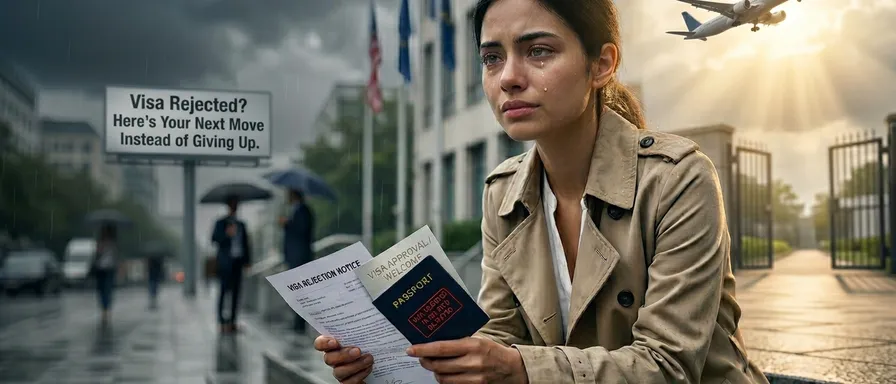
Few moments feel as discouraging for a student as getting a visa rejection. After months of researching universities, getting documents ready, passing language tests, writing applications, gathering papers, and dreaming of a future abroad, getting that rejection letter can feel like everything has fallen apart in one go.
For students, it's not just a visa rejection. It feels like their dreams are being rejected, too. The excitement quickly turns into disappointment. Family members start asking questions. Friends who got their visas seem to be moving forward.
Social media becomes hard to scroll, and somewhere in all that, a painful thought starts to grow: "Maybe studying abroad isn't meant for me."
But here's what many students don't hear enough: A visa rejection is a setback, not a verdict about your future. Every year, thousands of students worldwide face visa refusals for various reasons. Many of them reapply successfully, get approval, and study in their dream country. The difference isn't luck; it's understanding what went wrong and taking the next step instead of giving up.
At Pine Overseas, we often meet students who thought their study journey was over after a visa rejection. Today, many of those students are studying in universities worldwide.
If your student visa has been rejected, this blog will help you understand why it happens and what your next move can be — so you can move forward with confidence.
Why Visa Rejection Feels So Personal
The Dream Was Never Just About a Visa
The majority of students don't spend months preparing visa applications simply because they enjoy formalities; they do so because they are pursuing an aspiration — an aspiration to study in a prestigious institution, to receive exposure to the international community, to gain opportunities that will enhance their career paths, and lastly, to create a legacy within their family.
When a visa application is denied for any reason, the student will typically feel that the whole aspiration has vanished. After having gone through that experience, it is logically understandable to react emotionally. The issue arises because the student will perceive an immigration denial as their own personal failure.
Visa officers are not appraising your talent, intelligence, or industriousness in deciding whether to issue your visa. The officer will determine if your submitted application satisfies all immigration and visa requirements. That is an entirely separate perspective.
Social Pressure Makes It Feel Worse
Today's students have a unique challenge. Everyone's achievements are put on the internet. One friend gets a visa. Another shares photos from their college orientation. Somebody else is putting up their acceptance letter.
At the same time, students facing visa rejection often feel stuck. Comparison is stressful. Many students get caught up in self-doubt rather than focusing on solutions. They start doubting themselves when all they need is a game plan.
Remember this: Your timeline doesn't have to be someone else's timeline. Many successful international students had visa setbacks before they commenced their journeys.
What Does a Visa Rejection Actually Mean?
It Doesn't Mean Your Dream Is Over
This is one of the biggest misconceptions students have. A visa refusal does not automatically mean you can never study abroad. In many cases, students receive a rejection because of issues that can be corrected.
These may include:
Incomplete Documentation. Missing paperwork, incorrect information, or insufficient supporting documents can create concerns during the visa review process.
Financial Proof Issues. Many countries require clear evidence that students can support their education and living expenses. If financial documents are unclear, inconsistent, or insufficient, the application may face difficulties.
Lack of Clarity During Interviews. Some students struggle to confidently explain:
- Why they chose a particular course
- Why they selected a specific university
- Their future career goals
- Their academic plans
Even strong students can become nervous during interviews and unintentionally create doubts.
Weak Statement of Purpose or Study Plan. Visa officers want to understand the genuine purpose behind your international education plans. If your academic goals and future plans are unclear, it may affect the outcome.
Rejection Often Provides Valuable Information
Although it feels painful, a rejection can reveal exactly where improvements are needed. Instead of seeing it as failure, think of it as feedback. Many successful students receive approval on their second application because they use the first rejection as an opportunity to strengthen their case.
How to Move Forward After a Visa Rejection
Give Yourself Time to Process the Disappointment
Before doing anything else, acknowledge what you're feeling. You invested time, effort, money, and emotions into this journey.
Feeling disappointed is normal. Feeling frustrated is normal. Feeling confused is normal. What matters is not staying stuck in those emotions.
Allow yourself a little time to process the setback, but don't allow one decision to define your future.
Understand the Exact Reason for Rejection
One of the biggest mistakes students make is reapplying immediately without understanding why their visa was rejected.
Every rejection has a reason. The first step should always be identifying the specific concerns raised during the visa process. Once you know the reason, you can create a targeted strategy to address it. Without understanding the problem, it becomes difficult to improve the outcome.
Review Every Part of Your Application
Think of your visa application like a complete story. Every document, statement, interview response, and financial record contributes to that story.
Ask yourself:
- Was my financial documentation strong enough?
- Did my academic plan make sense?
- Could I clearly explain my career goals?
- Were all my documents accurate and complete?
- Did my interview responses reflect confidence and preparation?
A detailed review often reveals opportunities for improvement.
Strengthen Your Profile Before Reapplying
Sometimes a stronger application can make a significant difference. Depending on your situation, this may involve:
- Improving language test scores
- Strengthening financial documentation
- Updating academic records
- Gaining relevant work experience
- Creating a more detailed study plan
- Improving interview preparation
The goal isn't simply to submit another application. The goal is to submit a better application.
Seek Professional Guidance
Many students try to navigate the process alone after a rejection. While that may work in some cases, professional guidance can help identify issues that students often overlook.
At Pine Overseas, students receive support in understanding rejection reasons, strengthening applications, improving documentation, preparing for interviews, and building a stronger overall study abroad strategy. A second opinion can often reveal solutions that are difficult to see when emotions are involved.
Your Future Is Bigger Than One Rejection
One visa decision does not define your future. You are more than one rejection. One setback does not determine what you are capable of; it does not determine your potential.
Think about all the students who are really successful now. Many have stories about visa rejection, delays, uncertainty, and obstacles they had to deal with. They decided to keep moving forward.
You will look back at this moment in a year. You may not see it as the end of your journey, but as the tough time that taught you to be strong, patient, and determined. Having a life abroad is not always easy and perfect. Sometimes it is about being brave and continuing when things do not go as you planned — even when you have setbacks, even when you have visa rejection, even when you have delays, uncertainty, and obstacles.
Conclusion
Receiving a student visa denial can be upsetting, especially when you have spent several months preparing in advance for your international educational opportunity. Remember that receiving a student visa denial does not mean you will no longer be able to study abroad. In fact, usually it is simply an indication that there are additional things you need to improve on in your visa application, supporting documents, financial support, interview preparation, and/or study plan.
Rather than give up, try to determine why your visa application may have been denied so that you can improve your overall profile and provide yourself with a stronger application for the future.
At Pine Overseas, we believe students are not defined by their failures but by what they choose to do following their failures. With proper guidance, preparation, and mindset, a student visa denial can be seen as a temporary challenge instead of a permanent hurdle.
Your goal of studying abroad is still something you are capable of accomplishing. Sometimes it is just a matter of taking a stronger next step.
Start Your Global Education Journey Today
Let Pine Overseas guide you to world-class universities across the globe. Book your free counseling session and turn your dream of international education into reality.